Categories
guides

Cold emailing 102: I’ve sent the email, now what?

Now, you wait for their response. Cold emailing will often have a very low response rate, so it’s best to stay patient and see who responds.

After a few days of waiting and there’s still no response, here’s what you can do.

1. No response – following up

If your professors still haven’t responded after 1.5-2 weeks, then you can send a follow up email. Sending a follow-up email is essential because it demonstrates your continued interest and shows that you value the opportunity and are committed to the lab. Note that follow ups are generally on the shorter side and much more concise.

Here’s an example template:


Dear [Professor’s Name],

I hope this email finds you well! I remain enthusiastic about the possibility of contributing to your ongoing research projects, and would like to follow up on my previous email regarding a position at your lab.

I wanted to take this opportunity to reiterate my interest in joining your research team. I am eager to immerse myself in the research environment of your lab and apply my skills in [mention any relevant techniques or methodologies you possess]. I am more than willing to provide any additional information you may require, such as references or further details on my research experiences.

Thank you for your consideration, and I hope to have the opportunity to discuss my potential contribution to your lab in person or through a virtual meeting.

Best regards,

[Your Name] [Your Contact Information – Email Address, Phone Number]


2. Followed up, no response – now what?

If after another 1-2 weeks or so and you still haven’t gotten a response, then leave it be. It’s best not to send more than one or two—professors do check their email, and if they haven’t responded after your initial email and a follow up, then chances are they’re not interested.

In the meantime, take the time to do more research and email other professors. Consider applying for official university-affiliated programs or reaching out to other connections around you (including on social media).

Best of luck!

Categories
guides

Cold emailing 101: What is it, and how do I start?

What is cold emailing?

So, what is it? Cold emailing is a proactive approach to reaching out to potential employers, researchers, or professionals without any prior relationship or introduction. Most research internships, if not all, aren’t through official programs, are gained through cold emails. Through personalized emails expressing genuine interest in researching a specific field, you can demonstrate initiative and enthusiasm for scientific exploration. Cold emailing enables you to expand your network beyond conventional avenues (i.e. official summer programs), providing an opportunity to showcase your passion for science and your eagerness to contribute. By being genuine and enthusiastic, you can catch open doors to amazing opportunities that otherwise might not be widely advertised.

1. Pick your field(s) of interest

With numerous branches of science offering a wide range of fascinating topics, it can be overwhelming to pinpoint the perfect fit. To begin the journey, start by exploring your academic interests and passions. Reflect on any science courses, videos, movies, or any kind of media that have intrigued you—that you could see yourself truly enjoy studying. Consider the areas in which you felt a natural curiosity to learn more, and write down a list. Identifying these initial interests will serve as a foundation for narrowing down the fields later on.

Once you have a general direction, take a few hours to do some general internet research into the subfields within your chosen science discipline. For example, if you’re interested in biology, explore fields like genetics, ecology, neuroscience, or microbiology. Watch videos, read books, and scroll through articles. Additionally, it can help to take into account the societal relevance and potential impact of the research you are drawn to. Understanding how your chosen field contributes to addressing real-world challenges can add a deeper sense of purpose to your research pursuits. If possible, look for opportunities to attend webinars or workshops that expose you to these domains. If you don’t find yourself actively engaged in the topic and eager to learn more, then it might not be a preferable field and you can cross it off your list. You can end up with more than one interesting fields, and that’s okay!

Next, consider the practical aspects of conducting research in a specific field. Evaluate the resources available, such as research facilities or academic institutions that specialize in your chosen area. If you live near any kind of university, research their departments and see if they offer what you would like to study. Consider the resources and facilities available at each university. Some research projects may require access to specialized equipment, labs, or collaborative opportunities. Ensure that the universities you are considering can provide the necessary resources to support your research interests. Make sure to keep in mind transportation to and from the potential lab, as well as your time availability.

Remember that choosing a field of science to research is a dynamic and evolving process, and it’s essential to find a balance between what captivates your curiosity and what aligns with your long-term career aspirations.

2. Make a list of desired professors

Once you have your field(s) of interest and facility location(s) chosen, now it’s time to start making a list of possible researchers you’d want to work under.

Delve into the faculty profiles of the universities you are considering. Most researchers are either professors or associate professors at a university. Look for professors whose research aligns closely with your own interests. Oftentimes the professors will have a link to their lab website in their faculty profile, which will have much more detailed information. Pay attention to their publications, ongoing projects, and areas of expertise. Take note of any professors whose work resonates with you, and create a list of potential mentors.

It’s also beneficial to attend academic conferences, seminars, or webinars in your field, if possible. Although this definitely isn’t required, these events offer opportunities to connect with professors, ask questions, and learn more about their research and mentoring philosophy. Networking with professionals in your field can provide valuable insights and may even lead to further potential research opportunities.

As you compile your list of desired professors, prioritize them based on your level of interest and fit with your research goals. Having multiple professors from the same university department is totally okay, but it’s also beneficial to aim to have a diverse list of potential mentors, including professors from different institutions and research backgrounds. Keep in mind that crafting this list is a dynamic process, and your preferences may evolve as you gain more exposure to the research community.

3. Curate your resume

Curating and customizing your resume for a research position at a university lab is essential to showcase your academic qualifications, research experience, and passion for scientific inquiry. Start by creating a clear and concise resume that highlights your academic achievements, relevant coursework, and any research-related experiences you have had so far. Include your education, major, and any honors or awards you have received that demonstrate your dedication to academic excellence. If you haven’t had any prior research experience or notable awards, don’t worry! Some labs may require previous experience or qualifications, but most of the time they are just as open (if not more) to budding scientists. The PIs are usually professors—they teach students, and you’re here to learn!

If you do have experience, tailor your resume to emphasize research-related skills and experiences. If you have participated in any research projects or internships, describe them in detail, highlighting the methodologies used, data analysis techniques, and any notable findings or contributions. If you have presented your research at conferences or published any papers, be sure to include these accomplishments.

Include a section dedicated to technical skills that are relevant to the research position you are applying for. This might include laboratory techniques, software proficiency, or any specialized equipment you have experience using. Demonstrating your technical expertise will show potential mentors that you are well-prepared to contribute to their research team.

4. draft an email outline

Drafting a cold email outline for getting a research internship requires a structured and engaging approach to capture the attention of potential mentors. Start with a concise and professional subject line that clearly states your intention. Mentioning “Research Internship Inquiry” or something similar will immediately convey the purpose of your email.

In the opening paragraph, introduce yourself briefly, providing your name, age, and academic background. This should not be the bulk of your email, and should only be a few (if not one) sentences long

The second paragraph should express your enthusiasm and passion for the specific area of research you are interested in. Be specific! Explain what specific area you’re interested in, why you’re interested in it, and why this professor’s work aligns with your interests. It’s imperative you tailor your email to the specific research interests of the professor or lab you are reaching out to. Mention any publications or ongoing projects from the lab that have caught your attention and explain why their work aligns with your interests, which will show that you’ve done your research and are genuinely interested in contributing to their research team. This is arguably the most important part of the email, because it demonstrates your interest and proactivity. Professors can easily tell if you did your research on them or not based on what you say you’re interested in. (e.g., if you were to write to a professor researching protein synthesis about your passion for immunology, they will be able to tell you didn’t do your research thoroughly enough).

Next, describe your research experiences, if you have any. Describe any previous research projects, internships, or lab work you have been involved in, even if they weren’t related to your current potential field. This paragraph does not have to be long—a few sentences will do. Take a brief sentence afterwards to mention that you’re resume is attached, should they want to know more.

In the closing paragraph, express your eagerness to join their research team as an unpaid volunteer or intern. It might be trickier to explicitly say intern depending on which lab you’re emailing, as paid researchers are usually paid through grants and they might not be able to allocate enough funds for you. Request the opportunity to discuss the internship further, either online (like a phone call or video conference) or in person. Offer to provide any additional information they may need, such as sample works or publications.

Lastly, end your email with a professional and polite closing, such as “Thank you for considering my application” or “I look forward to the possibility of working with you.” Be sure to include your contact information, including your email address and phone number, so that they can easily get in touch with you.

Here’s an example template:


Subject: Research Internship Inquiry

Dear [Professor’s Name],

I hope this email finds you well! My name is [Your Name], and I am a [your academic year] at [your university/institution].

Throughout my academic journey, I have developed a strong interest in [specific research area of interest]. I was particularly intrigued by your work on [mention a specific project or publication from the professor’s lab], because [how the project aligns with your interests].

I have previously studied [mention any previous research projects, internships, or lab work you’ve been involved in]. It was an amazing opportunity, and I greatly enjoyed learning about [relevant knowledge you’ve gained], including learning and gaining experience in a variety of lab experiences from [list relevant techniques or methodologies you are proficient in] to [list other relevant techniques or methodologies you are proficient in].

I am impressed by the collaborative and intellectually stimulating environment of your lab, and I believe that working under your mentorship would provide me with invaluable learning opportunities. As an enthusiastic and dedicated individual, I am committed to contributing my best efforts to support ongoing projects and address research questions with rigor and creativity.

I am writing to inquire if there may be a possibility for me to participate in research activities in your lab, perhaps as a volunteer or unpaid intern. I am keen to contribute in any way and broaden my experience in [specific research area of interest]. I am open to arrange a meeting, phone call, or video conference at your convenience should you be interested.

My resume is attached for your review and I welcome any questions you may have.

Thank you for considering my application, and I look forward to your response.

Best regards,

[Your Name]
[Your Contact Information – Email Address, Phone Number]


6. Extra tips

1. send multiple emails / have backups

Sending cold emails to multiple professors is crucial to increase your chances of receiving a response and securing a research internship. Because the research landscape is competitive, professors receive numerous emails from interested students, and not all emails may be immediately noticed or responded to. By reaching out to multiple professors, you expand the pool of potential opportunities and increase the likelihood of finding a match with a research mentor who has availability and is interested in your academic background and research interests. While one professor may have limited availability for interns, another might be actively seeking motivated students to join their research team.

However, do NOT copy and paste each email to each professor. Although some professor’s area of research may be extremely similar, no two professors are studying the same exact area. You must tailor each email to each professor and their work in the lab in order to show them that you are invested in their work and not their colleague’s work.

2. Humble brag, but don’t be too cocky

If you have previous experience or projects that align with your interest, don’t be afraid to talk about them! Your email and resume are the only chance you get to tell them about your accomplishments. Take care to talk in a neutral tone, and avoid sounding too conceited. Though professors will definitely be looking at your past accomplishments, they are also looking to see who you are as a person. They take into account your personality and collaborative potential, making it really important to show them how your traits align with what they look for.

Best of luck!

Categories
guides

Getting started in the lab: basic laboratory techniques

Starting in a lab: basic techniques to learn

Are you about to start in a lab, but want to be prepared? We got you! Whether you are a student starting your journey in the lab or an aspiring researcher seeking to enhance your skills, mastering basic laboratory techniques is essential. In this guide, we will provide step-by-step instructions for three fundamental laboratory techniques: pipetting, preparing solutions, and working with microorganisms. These basic techniques are applicable to almost all fields, but are used especially when working in life science.

1. Pipetting:

Pipetting is the art of accurately transferring small volumes of liquid. It is crucial for performing experiments that require precise measurements.

Step 1: Familiarize with Pipette Types: Understand the types of pipettes available, such as single-channel and multi-channel pipettes, and ensure they are calibrated and in good working condition.

Step 2: Assemble the Pipette: Attach the appropriate disposable pipette tip to the pipette shaft, making sure it fits securely.

Step 3: Set the Volume: Use the volume adjustment dial to set the desired volume, ensuring it matches your experimental needs. All pipettes, since they’re in small volumes, will be in microliters (uL).

Step 4: Pipette Liquid: There are two “stops” in a pipette, which you will be able to feel. Press the plunger to the first stop, then slowly release to draw up the liquid into the pipette. Place the tip into the destination container and slowly press down the plunger to dispense the liquid. Pressing down the second stop will allow any extra liquid still stuck in the pipette to come out.

Step 5: Eject the Tip: Press the plunger on the other side of the pipette to dispose of the used pipette tip into a designated waste container, being careful not to contaminate other surfaces.

Remember: pipette tips are sterile, which means that if you accidentally touch a surface that’s not your solution or designated container, then you must discard the pipette and use a new one.

2. Preparing Solutions:

Accurate and precise preparation of solutions is critical for reproducible experimental results.

Step 1: Gather Materials: Assemble all necessary materials, including the solute (solid or liquid to be dissolved), solvent (liquid in which the solute is dissolved), and appropriate containers.

Step 2: Calculate Amounts: Calculate the amounts of solute and solvent needed based on the desired concentration and final volume of the solution. Concentration/molarity calculations usually use the concentration formula:

C1V1=C2V2

Step 3: Weigh or Measure Solute: Weigh the solid solute using an analytical balance or measure the liquid solute using a graduated cylinder or pipette.

Step 4: Mix Thoroughly: Add the solute to the solvent in the appropriate container and mix thoroughly using a magnetic stirrer, vortex mixer, or by swirling the container.

Step 5: Adjust pH or Volume (if required): If necessary, adjust the pH or final volume of the solution using appropriate techniques and reagents.

Step 6: Label and Store: Properly label the solution with its name, concentration, and date of preparation. Store it according to the required conditions, such as temperature and light exposure.

3. Working with Microorganisms:

Microorganisms are commonly used in research, and proper handling is crucial to avoid contamination and ensure safety.

Step 1: Sterile Techniques: Master sterile techniques, including proper handwashing, using a Bunsen burner to create a sterile work area, and using sterile equipment and media.

Step 2: Inoculation: Using a sterile inoculating loop or pipette, transfer the microorganism to the appropriate growth medium or experimental setup.

Step 3: Incubation: Place the inoculated medium or experimental setup in an incubator set to the appropriate temperature and conditions for the microorganism’s growth.

Step 4: Monitor Growth: Regularly monitor the microorganism’s growth, observing for any signs of contamination or other irregularities.

Step 5: Proper Disposal: After the experiment, properly dispose of any biohazardous waste, and follow lab safety guidelines for decontamination.

By mastering these basic laboratory techniques, you’ll enhance your research capabilities and ensure accuracy and reproducibility in your experiments. Remember to always adhere to laboratory safety guidelines and consult with experienced researchers or lab staff when learning new techniques! With practice and attention to detail, you’ll build a strong foundation for successful and meaningful scientific research. Goodluck!

Categories
guides resources

Navigating conferences and symposiums: tips for attending and presenting

Research conferences and symposiums bring together scientists, researchers, and scholars from diverse fields to share knowledge, present findings, and foster collaborations. Research conferences are larger events covering a broad range of topics with multiple presentations and diverse attendees. Symposia, on the other hand, are specialized, focused events with shorter durations, emphasizing in-depth discussions on a specific theme and attracting attendees with keen interest in that topic. Both provide valuable opportunities for knowledge exchange and networking among researchers and experts.

Presenting at a symposium can be an exciting and rewarding experience, offering an opportunity to showcase your research and receive valuable feedback. In this comprehensive guide, we’ll cover what to expect, how to prepare, essential oral presentation tips, and tricks to make your symposium presentation a success.

Understand the Symposium Format:

Familiarize yourself with the symposium’s structure, including the duration of your presentation, Q&A session, and any specific guidelines or themes set by the organizers. In a conference, you’ll usually be given a set duration of time. For a symposium, you are generally standing in front of your poster, and other people will come and ask questions.

Preparation is key:

  • Begin your preparation well in advance to have ample time for refining your content and polishing your delivery. Organize your thoughts, data, and key messages to create a coherent and impactful presentation. You generally will not have notes during your presentation, so make sure you fully understand your material before presenting.
  • Focus on conveying a clear and concise message. Structure your presentation logically, with a strong introduction, well-defined objectives, main findings, and a compelling conclusion.
  • Use visual aids like slides, graphs, and images to enhance your presentation and make complex concepts easier to understand. Keep the design clean, consistent, and avoid clutter.
  • Rehearse your presentation multiple times to become familiar with the content and improve your delivery. Practice in front of friends or colleagues to receive feedback. Remember to stay mindful of the allocated presentation time. Practice delivering your talk within the time limit to avoid rushing or exceeding the allotted time. For symposia, it’s generally good to have a few-minute elevator pitch.

Presenting:

  • Tailor your presentation to the symposium’s audience, which may include fellow researchers, scholars, students, and industry professionals. Adjust your language and level of technical detail accordingly.
  • Anticipate potential questions and prepare concise and accurate responses. Be open to feedback and engage in constructive discussions during the Q&A session.
  • Summarize your key points and reiterate the importance of your research. Leave a lasting impression by offering avenues for future research or applications.
A peek of one of our writer’s own symposium!

Other tips:

  • Networking Opportunities
    Take advantage of networking opportunities during breaks and social events to connect with other presenters, experts, and potential collaborators.
  • Enjoy the Experience:
    Remember that presenting at a symposium is a valuable opportunity to share your work and contribute to your field. Embrace the experience with enthusiasm and passion!

Goodluck!

Categories
guides

Applying to summer research programs: high school edition

What are high school research programs?

A high school summer research program is a unique opportunity for students to engage in hands-on research and exploration within their chosen academic fields. These programs are typically offered by universities, research institutions, and organizations. Summer programs are usually co-ed, residential programs that range anywhere from 6-8 weeks and often culminate in a final project or presentation. Participating in a summer research program demonstrates a student’s commitment to academic excellence and passion for their chosen field, making it a valuable addition to college applications. It can significantly enhance the chances of being accepted to competitive colleges and universities while offering a transformative experience that sets students apart from their peers. As exciting summer research programs as a high school student can be, most respected programs are often very competitive (think <10% acceptance rate). Here’s a guide on how to craft the best program application:

To start, most programs require the following:

  • Grades transcript
  • Test Scores
  • Letters of recommendation
  • Supplementary essays / personal statement
  1. Research Available Programs: Look for summer research programs at universities, research institutions, and organizations. Utilize online resources, directories, and databases that specifically cater to high school students seeking research opportunities.
  2. Check Eligibility Criteria: Each program will have specific eligibility requirements, such as grade level, age range, coursework completed, and GPA. Make sure you meet all the prerequisites before proceeding with the application.
  3. Start Early: Begin your search for summer research programs well in advance. Many applications have deadlines several months before the start of the program, so give yourself enough time to research and prepare. Most summer programs open their applications at the end of the year (Oct-Nov) and are due at the beginning of next year (Jan-Feb).
  4. Prepare Your Resume/CV: Create a well-organized resume that highlights your academic achievements, extracurricular activities, volunteer work, leadership experiences, and any previous research-related involvement. Some programs will ask for a resume, and some won’t. Make sure you know which programs ask and don’t ask to save time.
  5. Request Recommendation Letters: Many programs require letters of recommendation from teachers, mentors, or community leaders. Ask for letters from individuals who can speak to your academic abilities, research potential, and enthusiasm for learning.
  6. Write a Stellar Personal Statement: Craft a compelling personal statement that showcases your passion for the subject, explains why you want to participate in the program, and demonstrates your suitability as a candidate. Tailor your statement for each program you apply to. For those that ask for supplementary essays, make sure you start drafting and writing a few months before the deadline.
  7. Check for Financial Assistance: Some summer research programs may come with associated costs. If they do, they will also most likely offer financial aid or scholarships, so make sure to research what they offer.
  8. Submit Your Application: Complete the application accurately and submit all required documents before the deadline. Double-check that all materials, including transcripts, recommendation letters, and essays, are included.

Extra tips:

  1. Stay Organized: Keep track of the programs you’ve applied to, their deadlines, and any communication with program coordinators. An organized approach will help you manage the process effectively.
  2. Consider Backup Options: Apply to multiple programs to increase your chances of acceptance. Have a few backup options ready in case you’re not accepted to your first-choice program.
  3. Prepare for the Program: If you get accepted, familiarize yourself with the program’s schedule, requirements, and any preparations you need to make before the start date.
  4. Make the Most of the Experience: During the program, actively engage in research, ask questions, seek mentorship, and network with peers. Embrace the learning opportunities and make the most of the experience.
  5. Follow Up and Express Gratitude: After the program concludes, send thank-you notes to mentors, program coordinators, and anyone else who contributed to your experience. Networking and expressing appreciation can lead to future opportunities.
Categories
guides

How to look for summer programs

Here’s a guide on how to Google for summer research programs:

  • Look at colleges and universities. Almost any college/university will have their own research department, especially if they are an established research school. And if they have their own research department, then they will most likely have some sort of student program opportunity. All that do will most likely be geared towards undergraduate/graduate students, but high school programs are not uncommon.
  • Google for pre-existing compiled lists. Most college preparation websites will have already compiled lists of top research programs, so know how to search for those lists. You can try using these phrases:
    • Top high school research programs
    • top high school summer programs
    • top high school summer research programs
    • [your city] summer research programs
    • best high school research programs for [your specific needs]
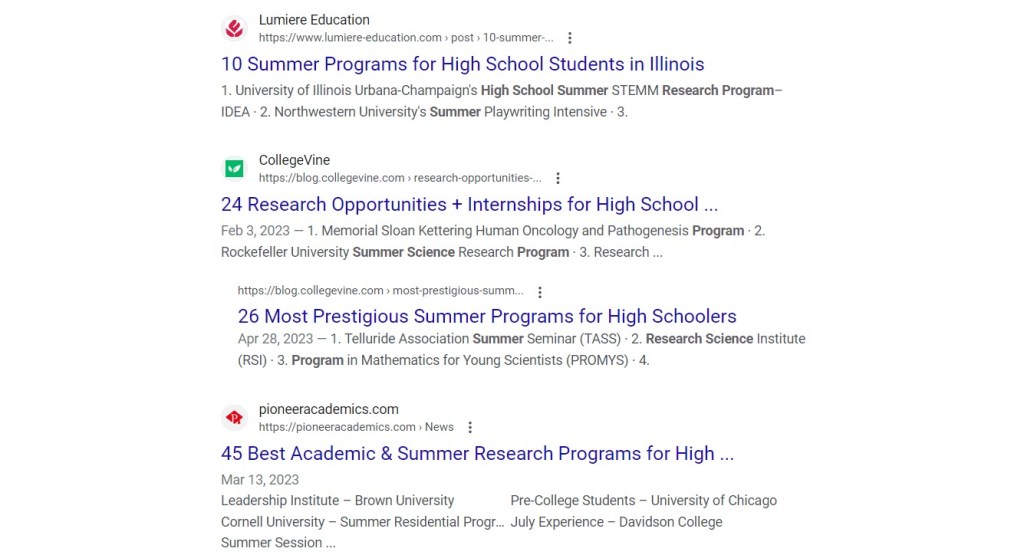
Results from searching “top high school summer research programs”
  • Use university-specific keywords. When googling for a summer program, use certain buzzwords that will help your results. Here are some words and phrases you can try searching:
    • [university name] high school research program
    • [university name] high school fellowship
    • high school research program
    • student research program
    • [university name] summer research program
    • [university name] high school research
    • [university name] student fellowship
    Note how all of these phrases generally contain “high school”, “research”, “summer”, “program”, “fellowship”, and “student”! Make sure to also include a university name because this will help narrow down your results and differentiate it from random, lesser-known programs.
Categories
informationals

Common laboratory terminology

If you’re starting lab research for the first time, or engaging in any science-related discussion, you’re going to hear a lot of words and phrases thrown around that you might not know. Here’s a list of common terms and phrases so you don’t have to ask later on!

  • Primary Investigator: the primary investigator, or PI, is the holder the lab’s research grant and the lead researcher for the grant project. You can think of this person as the boss of the lab or the head researcher.
  • Journal Publication: a scholarly publication containing articles written by researchers, professors and other experts. These are often published only a few times a year, and are the ultimate goal for any researchers. You’ll often hear someone go, “I’m going to be published in XYZ journal!” which means that their research project was published in that journal. Some journals are more prestigious than others, which is determined by their impact factor.
  • Assay: an investigative or analytic procedure for assessing or measuring the presence, amount, or functional activity of a drug. It’s used in a lot of laboratory settings, and can mostly be interchangeable with “experiment”.
  • Lab meeting: exactly what it sounds. Most, if not all, labs hold a weekly lab meeting, where all the people working in the lab will meet and one person will present updates on their work, usually in a form of PowerPoint presentation, and the rest of the lab will ask questions and discuss. The people presenting will rotate each week.
  • Journal club: All labs will also most likely have a journal club, where lab members will take turns each week choosing a scientific paper related to their field of work and present them in a meeting with the rest of the lab members.
  • Peer review: A type of research evaluation, used before a paper is published. Once a paper is submitted to a journal, the journal will have experts in the same field as the author review the paper for any mistakes or fallacies. This ensures the quality and validity of the research.
  • Methodology: The detailed description of the procedures, techniques, and materials used in a research study. It allows other researchers to replicate the experiment.
  • Literature Review: A comprehensive overview of existing research and publications relevant to a specific topic. This helps researchers understand the context of their work and identify gaps in knowledge.
  • Abstract: A concise summary of a research paper, typically located at the beginning. It provides an overview of the study’s objectives, methods, results, and conclusions. Usually around 300 words.
  • Protocol: A standardized procedure or set of guidelines for conducting experiments or research. This is pretty similar to methodology. Protocols ensure consistency and accuracy in data collection and analysis.
Categories
informationals

What is research?

What is research?

Research is the systematic and methodical investigation of a particular topic or issue to generate new knowledge, explore hypotheses, or solve problems. Any kind of research involves a rigorous process of data collection, analysis, and interpretation, often guided by a set of well-defined objectives and questions. Researchers aim to contribute to the existing body of knowledge, make evidence-based discoveries, and drive innovation in diverse fields, from science and technology to social sciences and humanities: a critical component of advancing human understanding and improving various aspects of society.

Different Types of Research:

There are various types of research, each serving unique purposes and applying specific methodologies. Two primary types of research are clinical and translational research.

Clinical Research: Clinical research is conducted to study human health and disease, involving human participants. This type of research typically includes clinical trials to test new treatments, interventions, or medical devices for their safety and effectiveness. Clinical research is vital for developing and improving healthcare practices, understanding disease mechanisms, and identifying potential therapies.

Clinical research opportunities are often much more limited for high school students, as clinical studies and trials require patient interaction, which involves strict rules and regulations.

Translational Research: Translational, also known as bench or wet lab, research bridges the gap between basic scientific discoveries and their practical applications in healthcare settings. It aims to translate scientific findings in the lab into tangible benefits for patients and the broader community. Translational research often involves moving scientific knowledge from the laboratory into clinical trials and eventually integrating the discoveries into medical practice.

Research mentors:

Research mentors play a pivotal role in shaping the success and growth of aspiring researchers. A mentor is an experienced individual, often a senior researcher or faculty member, who provides guidance and expertise to mentees as they embark on their research journey. One of the primary roles of a research mentor is to help the mentee identify their research interests and goals. Mentors also assist in the formulation of research questions and hypotheses, helping mentees refine their research ideas into feasible and well-defined projects. They offer critical feedback on research proposals and guide students in designing robust experimental methodologies or study protocols. Furthermore, mentors introduce mentees to networking opportunities and professional development activities. They may suggest attending conferences, workshops, or seminars to expand the mentees’ exposure to the broader research community and help them build valuable connections with other researchers.

Publication

The culmination of a research project (or any important finding) often leads to publications, where researchers write an article describing their experimentation and findings and publish in an academic journal. Before research findings are published, they undergo a peer review process. In this process, independent experts in the field critically evaluate the research methodology, data analysis, and interpretation to ensure the study’s validity and quality.